Shaun Temby
Shaun has over two decades of expertise in commercial disputes, competition, and consumer law and provides strategic legal solutions to franchising and consumer markets clients.
View profile
This year marks a milestone: the tenth edition of our Year in Review publication. A decade of charting the Australian Competition and Consumer Commission's (ACCC) priorities, its wins and losses, and the evolving issues and challenges shaping competition law and consumer protection in Australia. Looking back over ten years of commentary, what stands out is not only how profoundly the regulatory landscape has shifted, but how consistently the ACCC has positioned itself at the centre of national conversations about fairness, integrity and market performance. In doing so, the ACCC has consistently and assertively expanded into new areas of responsibility while doubling down on its fundamentals.
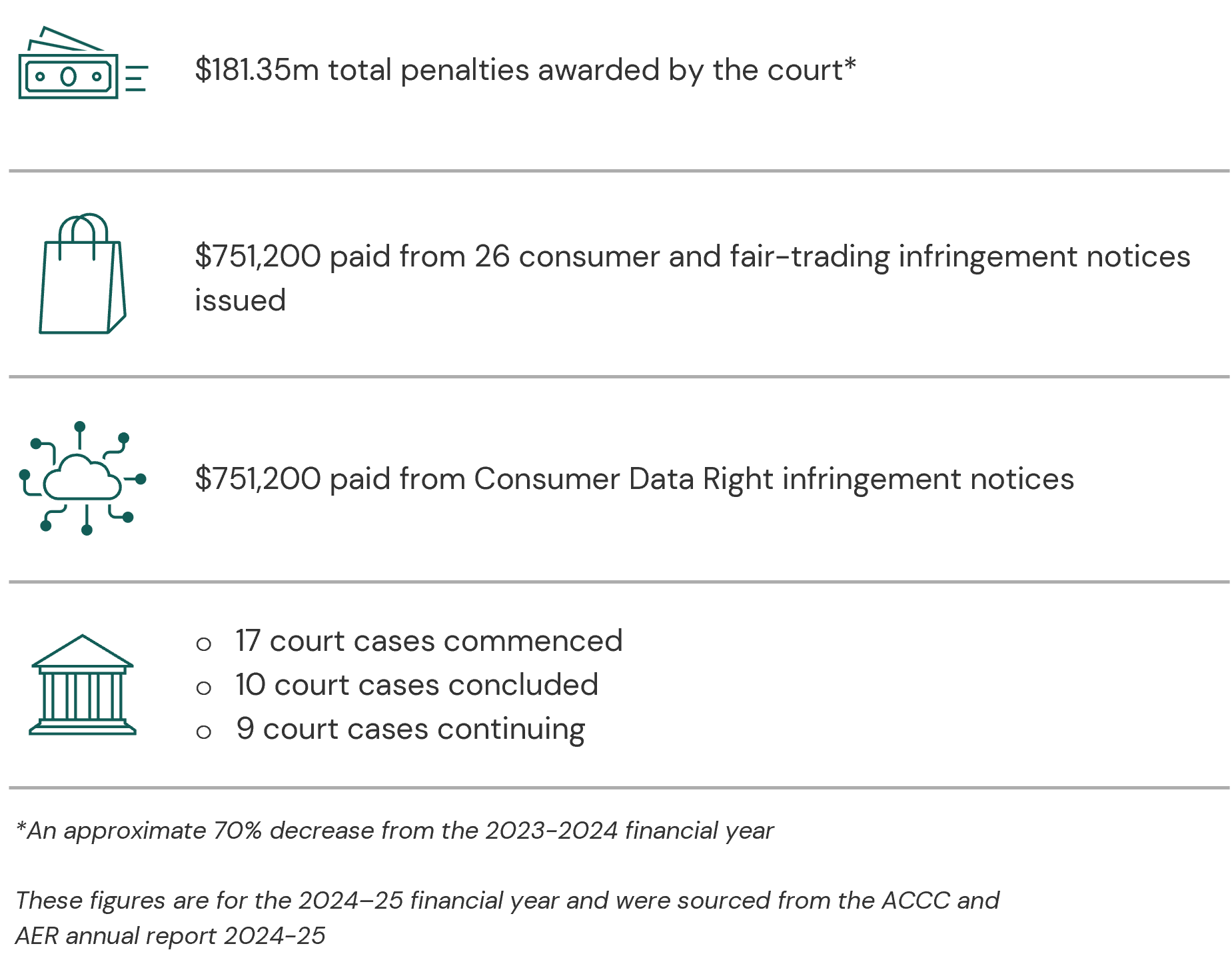
2025 was an important year for the franchise sector, with the final provisions of the changes to the Franchising Code of Conduct (new Code) taking effect in November. We observed the ACCC transitioning from a period of regulatory education and consultation to more active enforcement, issuing infringement notices to several franchisors for non-compliance with the Franchise Disclosure Register and securing a $1.5 million contempt penalty against Ultra Tune. The release of updated guidance materials by the ACCC clarified key obligations under the new Code, including those relating to capital expenditure, cooling-off periods and return on investment. With a $7.1 million boost to its enforcement budget, we expect the ACCC to intensify its scrutiny of major franchisors this year, particularly targeting systemic non-compliance and breaches that undermine transparency and fairness for franchisees.
The ACCC’s activity in consumer markets and retail during 2025 was defined by a sharpened focus on subscription traps, misleading pricing, and unfair contract terms. Enforcement actions against major retailers such as The Good Guys and Webjet demonstrated a commitment to pricing transparency, while proceedings against Microsoft signalled a new willingness to challenge opaque and potentially “unfair” subscription practices. The ACCC also laid the groundwork for enforcement under the expanded unfair contract terms (UCT) regime, issuing warnings to businesses in sectors such as gyms, streaming and food delivery. Although no UCT test cases were filed in 2025, this year we expect further industry sweeps in this area as well as more litigation. With cost-of-living pressures persisting, the ACCC is likely to maintain pressure on supermarkets, pursue further reforms to introduce “unfair practices” prohibitions, enhanced consumer protection in digital markets and further work on embedding the “right to repair” in the motor vehicle sector and adjacent industries.
Misleading and deceptive conduct remained a frontline enforcement priority again last year, with the ACCC confronting an expanding array of advertising and sales practices that risked distorting consumer choice. The ACCC’s performance last year was marked by successful, targeted compliance “blitzes” on misleading pricing, subscription traps and opaque add-ons, alongside infringement notices and public warnings directed at retailers, service providers and digital platforms. In short, as we predicted, not a lot of new court proceedings in this space, however, the ACCC’s administrative actions underscored its ongoing insistence that businesses maintain accuracy and clarity, in consumer-facing claims across a wide range of sectors. Looking to the year ahead, we predict more “sweeps” or blitzes targeting poor retailer behaviours, possibly a renewed focus on greenwashing claims, an escalation in cases testing the extended unfair contract regime, a firmer stance on misleading pricing, surcharging and ‘gouging’ in priority sectors, and a new phase of enforcement targeting dark patterns, personalised pricing, and (maybe) AI-driven misrepresentation.
In contrast to the uptick in enforcement activity in consumer markets, last year new cartel matters were fewer in number, but no less significant. Our authors highlight several high-impact cases: civil penalty proceedings involving major suppliers for alleged price fixing, enforcement action in the area of Defence procurement, the Full Court’s reinforcement of legal principles in BlueScope, and the $55 million agreed penalty against Google. The ACCC’s performance in this area is characterised not by volume but by precision: carefully built cases, crystallisation of key legal tests, and significant new proceedings alleging cartel activity economically significant markets. Having said that, its worth noting that we still haven’t seen a new criminal cartel prosecution despite the various civil proceedings that were commenced. This year, we predict greater prosecution of cartels and other anti-competitive activity, as the strengthened Immunity Policy matures, with more whistleblower-driven investigations and heightened attention to price-fixing risks in cost-of-living sectors and digital markets.
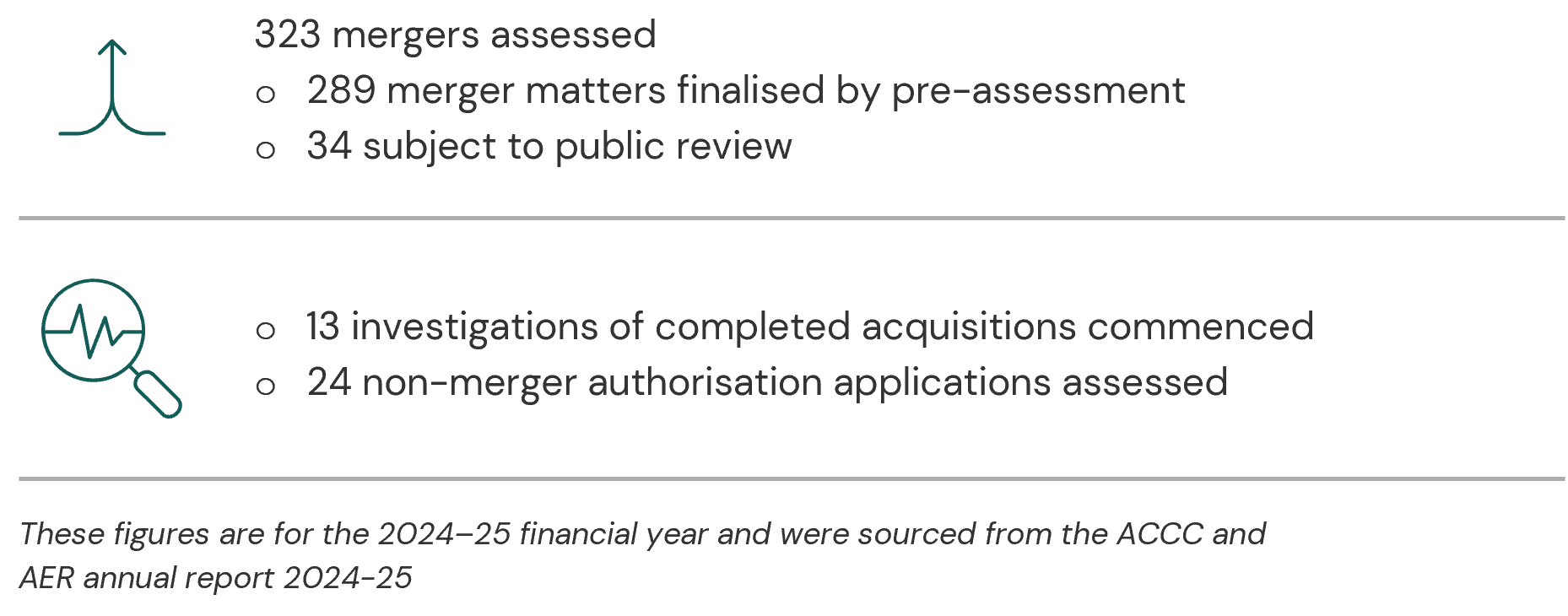
Last year, the ACCC navigated a transformative period as the new mandatory notification regime evolved, significantly reshaping its role in overseeing structural changes across the economy. At the same time, as expected, we observed a regulator willing to approve transactions that preserve competition (as in the Vocus–TPG decision), but equally willing to signal caution when market concentration threatens consumer harm, in deals such as IAG/RAC and Yamaha/Telewater. Looking to 2026, we anticipate more rigorous merger reviews under the new regime, test cases that clarify how the new regime will operate, and a heightened willingness to challenge deals in concentrated sectors such as telecommunications, energy, transport and digital platforms. The coming year will also be significant as an initial test for the new merger regime’s effectiveness, the extent to which the ACCC relies on its waiver powers, and for the ACCC’s capacity to manage its expanded remit.
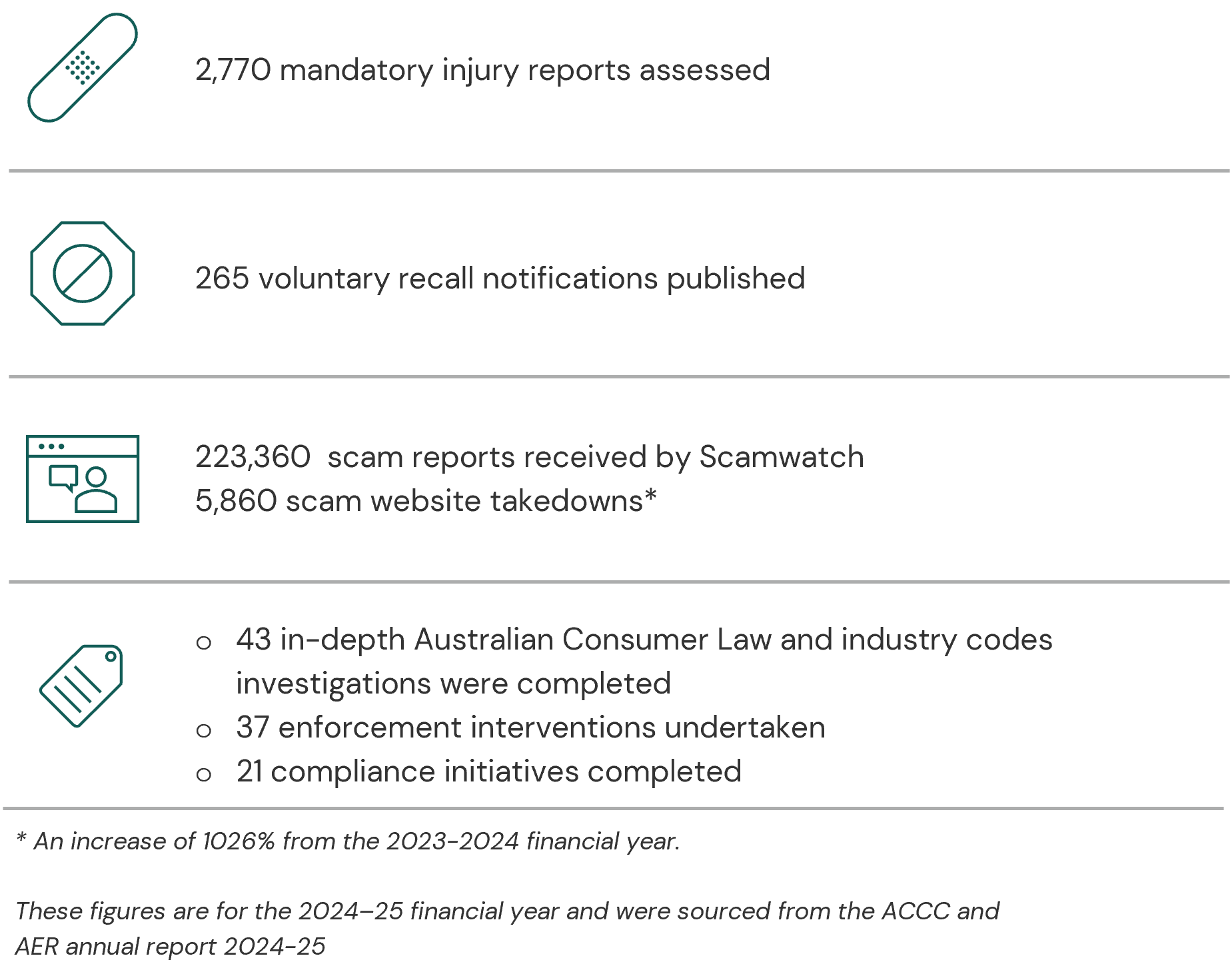
Over the past year, the ACCC has drawn attention to emerging product safety risks while potentially holding back its heaviest enforcement tools for the right test case. The ACCC’s work this year centred on new areas, such as heightened warnings about lithium-ion batteries and intensified surveillance of online marketplaces and imported goods, as well as on old and familiar causes like unstable furniture and unsafe infant sleep products. While button‑battery enforcement reached the courts for the first time, the ACCC has yet to bring court action on lithium-ion battery safety or marketplace obligations. Looking ahead, in 2026, we predict initial enforcement actions (even if via infringement notices) against suppliers of high-risk battery products, actions against marketplace operators for failing to block unsafe goods, and stepped-up public education campaigns concerning all of these types of products.
Cost-of-living issues formed the connective tissue of the ACCC’s work across multiple portfolios this year, from grocery pricing and energy bills to poor retail marketing practices – particularly, online. In 2025, the ACCC continued to position itself as an important intermediary between households and markets: exposing uncompetitive energy plans, highlighting aggressive marketing tactics, such as short offer periods and misleading discount promotions, and maintaining pressure on the major supermarkets through the ongoing Grocery Inquiry. Its performance in this area is measured more by influence than numerous Court proceedings as it shaped public understanding, pressed industry to correct opaque or unfair practices, and used compulsory information‑gathering powers to highlight price movements and margin trends. This year, we predict a deeper examination of price dynamics in essential goods and services, sustained scrutiny of airline fees and surge pricing, a push for clearer disclosures and simpler contract structures in energy markets, and reforms to unit pricing and subscription practices.
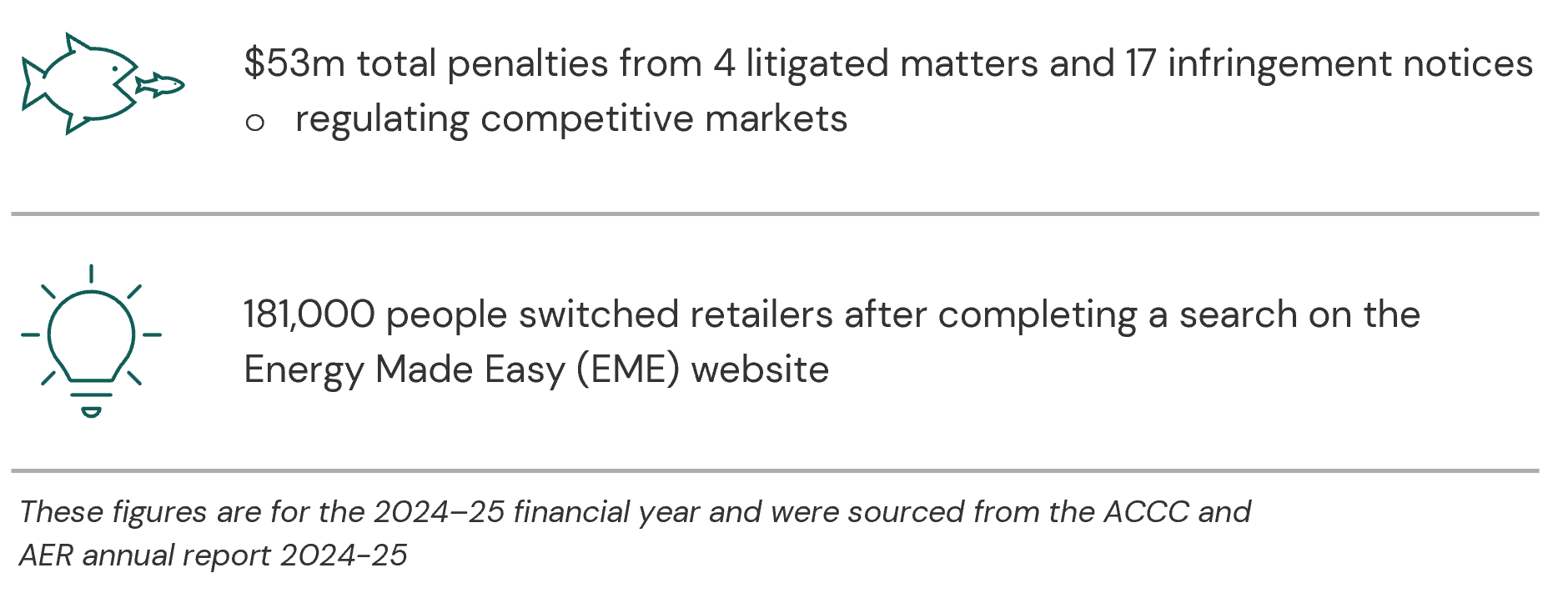
In 2025, the Australian energy sector was under pressure – from households grappling with outdated electricity plans, the need for ongoing government rebates and ongoing volatility in gas markets. The ACCC’s work spanned enforcement, market monitoring and public guidance. It highlighted price discrepancies, deficiencies in the provision of mandatory information to consumers by Energy retailers, and the limited impact of existing gas market controls. The authors of our ‘Energy’ chapter conclude that the ACCC met its objectives as a watchdog and educational body, even as the underlying structural challenges to energy markets remain acute. Looking forward, we predict focussed investigations into energy retailers, further scrutiny of gas traders, a new enforcement priority concerning protections for consumer’s purchasing rooftop solar and home batteries and a renewed focus on cost-of-living issues, such as misleading energy plans.
Last year, we observed the ACCC’s willingness to intervene decisively in telecommunications when serious consumer detriment was present. Penalties for misrepresentations about download speeds, breaches of functional separation rules, and unconscionable conduct underscore the ACCC’s seriousness to act on such matters. The new mandatory merger notification regime looms large, with the ACCC signalling it will scrutinise structural changes in the sector. Overall, our authors conclude that the ACCC performed strongly against its priorities by delivering compensation to affected customers, enforcing separation rules and setting clear behavioural expectations for Australian telco’s. The year ahead is expected to bring even more intense oversight: stronger action on pricing, speed claims, scams, coupled with the rollout of Scams Prevention Framework codes and further consumer data right.
The ACCC continues to navigate a rapidly intensifying set of challenges at the intersection of technology, competition and consumer protection. The ACCC’s work in 2025 reflected its dual role as investigator and policy shaper: advocating for targeted digital platform regulation, contributing to the national AI policy framework, and laying the groundwork for a permanent Digital Platforms Regulation forum. It continued to push forward the expansion of the Consumer Data Right into new sectors (such as energy and telecommunications), emphasising data portability and transparency as core competition levers. The ACCC’s performance was characterised by steady pressure on dominant digital players, careful monitoring of emerging harms (including, various dark patterns) and an evolving set of expectations around platforms’ responsibilities. As we look to 2026, we predict the ACCC’s first enforcement actions under the Scams Prevention Framework, increased scrutiny of dark patterns and personalised or surge pricing, and possibly fresh litigation relating to anti-competitive behaviours in the online digital economy.
Taken together, our review of the ACCC’s activity last year, reveals a regulator that has pushed fairly strongly where the law is largely settled (franchising, unfair contracts, telecommunications misconduct), moved carefully where evidence thresholds require patience (the obvious area being cartels), and maintained strong surveillance in sectors strained by structural and policy uncertainty (such as energy). However, our analysis also identifies limits and raises questions where we expected to see more activity, such in gas markets, which continue to defy simple regulatory responses and in the enforcement of unfair contract terms, where despite the introduction of a strengthened legislative regime, the ACCC has yet to bring a test case to court. Finally, the ACCC’s significant policy and regulatory victory in shepherding the passage of the new merger regime into law will now mean that its ability to deliver on the promised benefits of this new regime will be very closely watched.
Our annual examination of enforcement and regulatory activity by the Australian Competition and Consumer Commission.
Shaun has over two decades of expertise in commercial disputes, competition, and consumer law and provides strategic legal solutions to franchising and consumer markets clients.
View profileKeep up to date with our legal insights and events
Sign up
Victorian Supreme Court reinforces the importance of timely estate planning.

Software escrow is a well-established but frequently misunderstood risk mitigation mechanism in procurement contracts.

City Beach lost its appeal against the $14m penalty imposed by the Federal Court for supplying non-compliant products.

We unpack recent findings and explore implications for retailers and businesses running promotional pricing campaigns.
Partner
Sydney