Shaun Temby
Shaun has over two decades of expertise in commercial disputes, competition, and consumer law and provides strategic legal solutions to franchising and consumer markets clients.
View profile
A recent Federal Court case has highlighted the risks that can arise for investors in start-up companies being pushed out of management, even when they own half of the company. The decision offers valuable insights into how courts will assess oppressive treatment of shareholders where the claims arise between equal shareholders. This case highlights the importance of having a strong and unambiguous shareholder agreement ensuring investors’ roles are understood and that the parties have agreed on limits to the power of key decision-makers.
The Corporations Act 2001 (Cth) offers protection to minority shareholders against egregious conduct by other shareholders – known as a claim for protection from ‘oppressive conduct’, which frequently takes the form of the minority shareholder being excluded from decision-making or a fair share of profits. When that occurs, the shareholder of the company (usually a minority shareholder) can bring an action against the other shareholders if the conduct of a company’s affairs (such as an actual or proposed act or omission by or on behalf of a company or a resolution, or a proposed resolution, of members or a class of members (ie. shareholders) of a company) is either –
An oppressed shareholder can seek remedies under the Corporations Act and the court has broad discretion under this section to make any order that it considers appropriate in relation to the company. That power includes the ability to order the winding up of the company, changes to the company’s constitution or the majority shareholder to buy out the minority shareholder.
The recent Federal Court case concerned the irretrievable breakdown of a business relationship between Ms Alexandra Commins and Mr James Angelis, concerning their respective interests in Goldstone Fund, a venture capital private equity fund. Ms Commins alleged she and her investment vehicle – WIJOAV Services Pty Ltd – were being oppressed by several other shareholders controlled by Mr Angelis. Ms Commins’ (through WIJOAV), and Mr Angelis’ corporate vehicle, Angel Holdco, each held 50% of two companies (Goldstone PE and Goldstone FM), and together with two partnerships (VCLP and VCMP) formed the Goldstone Fund. Ms Commins served as Managing Director of both companies, was responsible for sourcing, executing, and managing investments for VCLP and raising capital and overseeing fund operations.
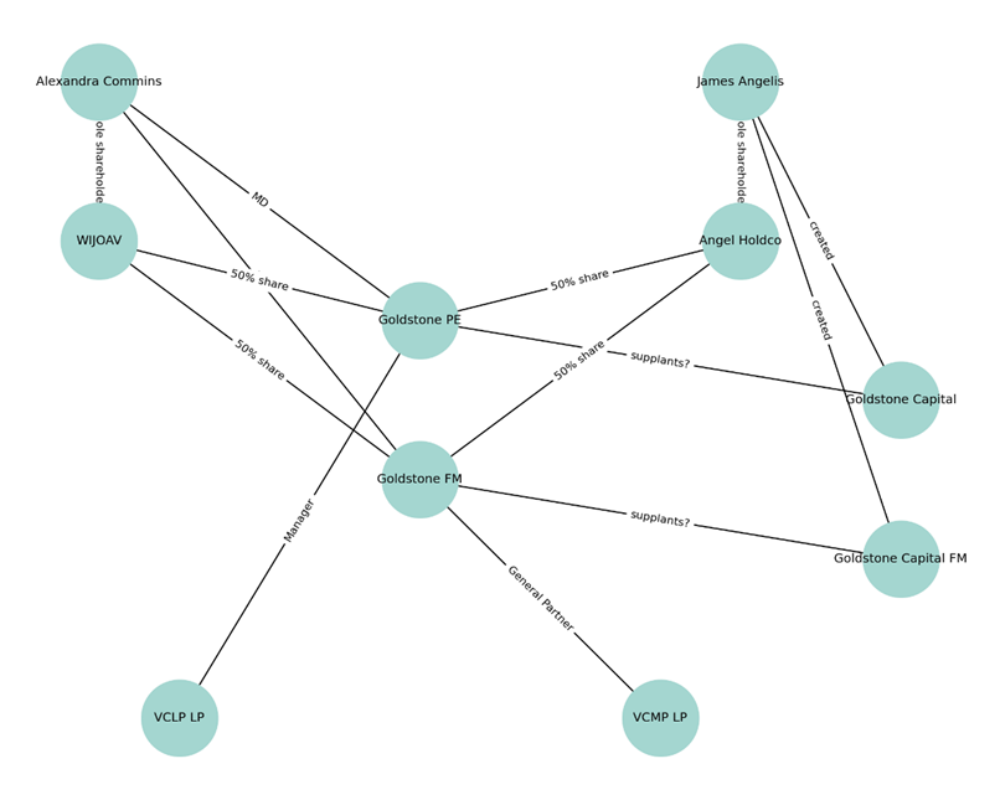
Relevantly:
Due to these actions by Mr Angelis, Ms Commins was excluded from any role in the management of the Goldstone Fund.
Ms Commins challenged Mr Angelis’ conduct on the basis that it was oppressive even though she wasn’t a minority shareholder when compared with Mr Angelis’s interests. Ultimately, Justice Jackman found Mr Angelis had treated Ms Commins oppressively. In deciding the case, Justice Jackman accepted that “this [was] not a case in which an evenly divided shareholding corresponded to an equality of power in controlling the companies’ affairs.” However, Mr Angelis was able to use a mechanism in the VCLP partnership deed to gain control of the company and remove Ms Commins from management despite her 50% shareholding. Additionally, he found the exclusion of Ms Commins’ from management by terminating her employment as Managing Director was wholly motivated by Mr Angelis’ “ill-tempered resentment at Ms Commins not agreeing to transfer… insurance broking work to his son’s business”. These matters ultimately led to Justice Jackman finding that the termination of Ms Commins was unfair, unlawful and invalid.
Subsequently, Mr Angelis sought leave to appeal Justice Jackman’s decision before final orders (including, orders as to damages) were made in the proceedings. The application to appeal was lodged on 26 June 2025 but was refused by Justice Moshinsky on 29 July 2025. After the refusal, Mr Angelis lodged an interlocutory application on 22 October 2025 seeking to disqualify Justice Jackman from hearing Ms Commins’ claim for damages on the basis of apprehended bias – as he had found in favour of Ms Commins in the liability proceedings. Justice Jackman dismissed that application on 28 October 2025 and unsurprisingly found that he was “unable to see any reason why [he] should disqualify [himself] from hearing the balance of the issues in these proceedings.” The damages hearing will now be heard in May 2026.
1) Equal shareholding does not guarantee equal control
Even in a 50/50 ownership structure, one party can dominate decision-making. Courts will look at actual conduct and control, not just share percentages and, if one party uses structural mechanisms to exclude the other, oppression may be found.
2) Governance documents are critical
The Shareholders’ Deed and Partnership Agreements were central to the Court’s analysis and investors should ensure these documents are comprehensive and enforceable.
3) Oppression can extend beyond companies
Although oppression claims typically apply to companies, the Court found that intertwined partnerships can also be caught by the Statutory regime. If partnerships operate through corporate entities, the oppression regime may, therefore, apply to the entire structure.
4) Motive matters
The Court found that Mr Angelis’ actions were driven by personal resentment, not legitimate business concerns. His attempts to exclude Ms Commins for refusing to divert business to a related party were viewed as oppressive and unfair.
This decision serves as a reminder that ownership alone does not equal control. Investors in start-ups should prioritise robust governance frameworks, including clear shareholder agreements, to safeguard their involvement in management. Courts will look beyond share percentages to actual conduct, and where personal motives drive exclusionary behaviour, it can amount to oppression. Importantly, these protections may extend beyond companies to partnerships operating through corporate structures, making comprehensive documentation and agreed decision-making limits essential.
Sign up to receive our latest legal updates
Shaun has over two decades of expertise in commercial disputes, competition, and consumer law and provides strategic legal solutions to franchising and consumer markets clients.
View profileKeep up to date with our legal insights and events
Sign up
The Government released a Consultation Regulation Impact Statement that could reshape product safety regulation.

Victorian Supreme Court reinforces the importance of timely estate planning.

Software escrow is a well-established but frequently misunderstood risk mitigation mechanism in procurement contracts.

City Beach lost its appeal against the $14m penalty imposed by the Federal Court for supplying non-compliant products.
Partner
Sydney