Catherine Dunlop
Catherine is one of Australia's leading lawyers working with clients on work health and safety (WHS), behavioural investigations and inquests, inquiries and Royal Commissions.
View profile
Victoria’s new Psychosocial Health Regulations were made yesterday to come into effect from 1 December 2025. The Regulations will require employers in Victoria to identify psychosocial hazards and control risk, so far as is reasonably practicable. Importantly, reliance on information, instruction and/or training will not constitute compliance with the employer’s duty unless the employer has applied the de facto hierarchy of control, focusing on elimination of risks, and considering the employer's management, systems and design of work.
The new Regulations define the hazards as ‘any factor or factors in -
(a) the work design; or
(b) the systems of work; or
(c) the management of work; or
(d) the carrying out of the work; or
(e) personal or work-related interactions
that may arise in the working environment and may cause an employee to experience one or more negative psychological responses that create a risk to the employee's health or safety’.
A non-exclusive list of hazards is provided, replicating the content in current WorkSafe Victoria guidance material. That list is:
This list differs from the list in the Safe Work Australia Code of Practice in minor ways, notably that harassment (not limited to sexual harassment) is included in that Code. Significantly, the list does not include a hazard of use of AI, as is currently contemplated in New South Wales.
The Regulations require employers to identify psychosocial hazards so far as is reasonably practicable. This will require consultation in accordance with the obligations in the Occupational Health and Safety Act 2004 (Vic), and reviewing information available to employers including incident reports and complaints.
Employers must also control psychosocial hazards by, so far as is reasonably practicable:
This de facto hierarchy of control will require a new approach from P&C teams, who should draw on the expertise of their OHS team to assist in risk assessment and review of controls. It will also be important for this to be a continuous process, where this hierarchy is applied to changes in work (increased demands) as well as uncivil behaviour (poor culture, bullying).
WorkSafe Victoria have summarised this in their Compliance Code as follows:
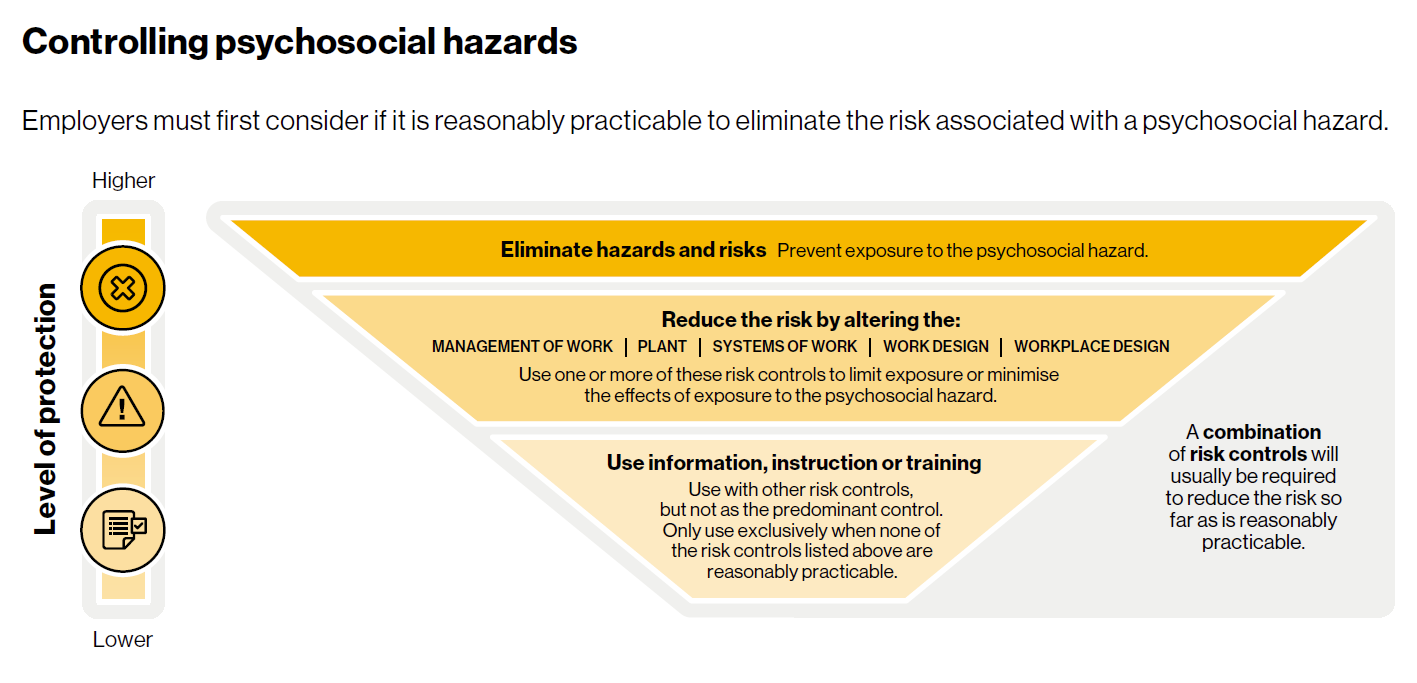
The Regulations do not include the requirement for Prevention Plans or reporting to WorkSafe Victoria as was foreshadowed in the 2021 draft. In many cases development of Prevention Plans, through consultation, will be an effective tool to address and prevent harm. WorkSafe Victoria’s guidance notes ‘Whilst the use of prevention plans is not mandatory, WorkSafe Victoria does encourage employers to use the template that has been developed.’ This template can be found here.
Job design is defined in the Regulations to mean ‘equipment, content and organisation of an employee's work tasks, activities, relationships and responsibilities within a job or role’ [emphasis added]. We have been advising for some time this will require detailed and appropriate job descriptions, and assessment of performance and workload against that job description. It may also allow for job crafting, when reasonably practicable, to allow employees to increase engagement and productivity,
The Regulations also contain significant changes in relation to consultation duties with contractors, and engagement with Health and Safety representatives, including in issue resolution.
WorkSafe Victoria has also this morning released its Code of Practice providing further guidance. Read more at Compliance code: Psychological health | WorkSafe Victoria. We will provide a summary of that for you soon, but we recommend that you review this in detail to understand how it impacts on your organisation
What should employers focus on?
The new Regulations will require a focus on assessment of risk, and empowering leaders to address risk. Many of these leaders may require support to understand their role.
Boards and Executive Teams should be developing a mature understanding of the psychosocial hazard profile in their organisation, consistent with their role as Officer.
We are running a webinar for existing clients on Wednesday 29 October at 11:30am - 12:30pm AEST. Partners Catherine Dunlop and Dale McQualter will be answering questions on the new Regulations and the Code.
Catherine is one of Australia's leading lawyers working with clients on work health and safety (WHS), behavioural investigations and inquests, inquiries and Royal Commissions.
View profileKeep up to date with our legal insights and events
Sign up
Victorian organisations engaging people in child-related work will face new Working with Children Check requirements.

We provide practical steps employers can take to comply with the current legal framework.

Changes to employment arrangements for Council CEOs and the framework provided for the Local Government Fair Jobs Code.

Victoria steps towards becoming the first Australian jurisdiction to legislate a statutory right to work from home.
Partner
Melbourne